
Linda Leven, a 76-year-old muse with an insatiable hunger for fame
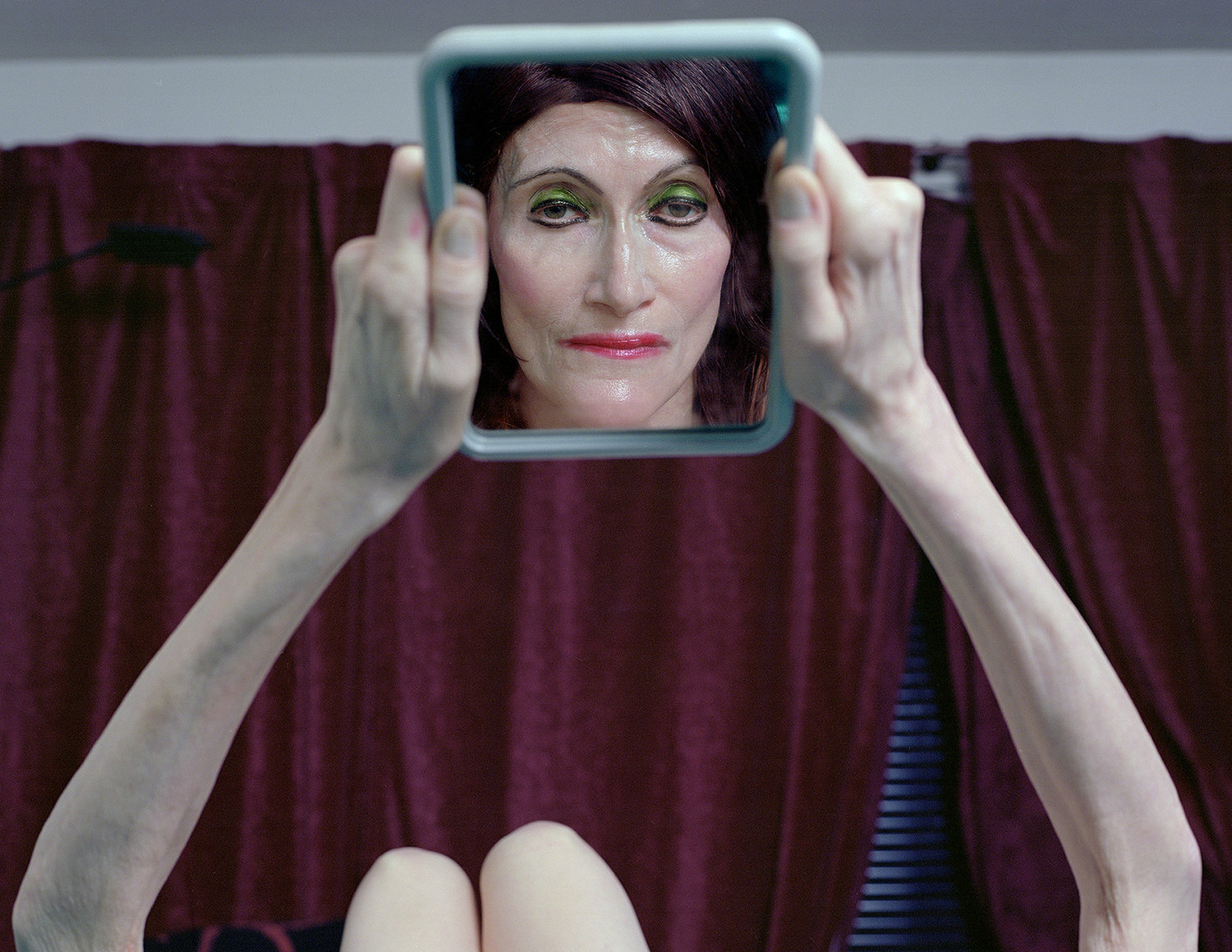
Linda Leven by Elizabeth Bick, published in “Coda.”
When Linda Leven picks up the phone, there’s a cacophony of background noise on the line. “I have five sound machines going and an opera,” she tells me, and excuses herself for a moment while she figures out how to turn them all off. “Listen, Audrey,” she begins, “I’m working here under difficult conditions, so I don’t know how far I’m going to get, being an old geezer. You know what my age is, right?”
At 76, Leven is afflicted with various maladies, and she begins to warn me of the nerve in her throat that tends to act up, causing her to cough uncontrollably. “Being old, you always have some handicap,” she says. Despite her forewarning, we make it through the interview without a hiccup – or a cough.
I first came across the likeness of Linda Leven at the Meredith Rosen Gallery in New York City – a small space in the basement of a townhouse near Central Park – where the Tali Lennox show, “The Ballad of Linda Leven” was on display. The show had been named after one of its paintings, a portrait that Leven had modeled for. Each painting within the show was an eerie, photorealistic capture of its subject altered with exaggerated proportions, intense makeup, and Draculean features.
Linda Leven had never heard of Tali Lennox – or Annie Lennox for that matter – when the daughter of the internationally known singer-songwriter reached out to her and asked if she would be willing to sit for a portrait. Leven had played muse many times before, her angular face and striking makeup catching the eye of New York artists who immortalize her eccentricity in photographs and on film.
“[Tali’s] got a huge studio down on Canal Street. Kind of a spooky place,” Leven said. “You ride this freight elevator up to it. She shot, I’d say, 200 photographs. She dressed me up in various outfits that she had, and she just shot here, there, everywhere from different angles, and that was it.” Leven was expecting a serious portrait, her own “Mona Lisa.” The end result was more of a perverse “American Gothic,” trading a colonial apron for a cropped, tropical shirt with a matching skirt, and a pitchfork-wielding husband for a predacious eyed vampire.
“I had seen a little bit of the painting before. Tali showed me some ideas that she had, so I knew that it would be almost a caricature. I thought, ‘Oh my God, I’m going to have a beautiful profile, a painting. Then what did I turn out to be? A vampire. What the hell, I like it. I like her style, and I think she did catch my essence. I don’t call it a serious portrait of myself. It’s not a Rembrandt,” she says, not insultingly.
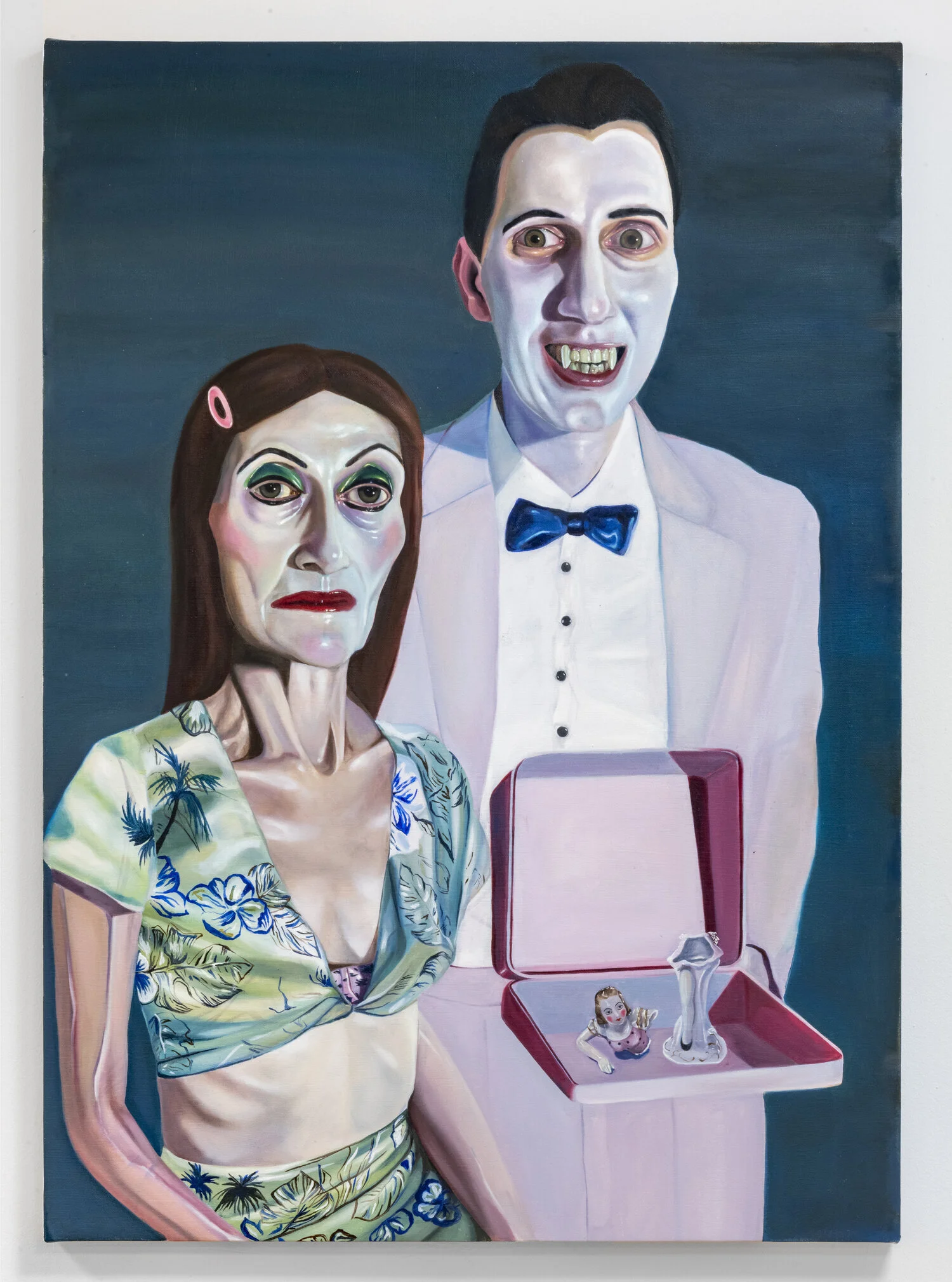
“The Ballad of Linda Leven” by Tali Lennox. Image use granted by Meredith Rosen Gallery.
In “The Ballad of Linda Leven,” a pink barrette pulls a slab of dark brown hair away from Leven’s face and behind her neck, contrasting against a generous amount of glossy white foundation, her eyes coated with emerald green eyeshadow and lined with thick, black pencil. Her eyebrows are arched into a rounded point in the center, her cheeks cotton-candy pink and her lips as crimson as the blood of her co-subject’s imagined victims.
It’s the same look that she has been wearing since she was a teenager – one that has survived decades and decades of dismissed trends, a signature mask that she created after seeing Tchaikovsky’s “Swan Lake” as a girl, inspired by the dramatic eye makeup worn by the ghoulishly feminine ballerinas. Whether running an errand, or on a date, or simply walking down the street, this is the face Linda Leven wears, luring in artists like Lennox to immortalize her in their work.
Accompanying each of Lennox’s paintings is a vignette of horror, a backstory pairing with the unearthly subjects. As for Linda’s story, the viewer will be drawn to a box held by her vampire companion, which holds a broken porcelain figurine of a ballerina. The ballerina’s torso – with her head and one arm attached – lie to the left of the base of the figurine, which retains just one leg and ballet shoe. According to the artist’s vision as per the show’s press release, the vampire symbolizes Leven’s desire for everlasting life, the broken ballerina figurine her unfulfilled dreams of becoming a renowned ballerina.
Her appearance, as portrayed in Lennox’s painting, elicits strong reactions from those around her, even cruelty from strangers on the street – casual human viciousness that barely seems to phase Leven. “People see me on the street, I have a very bizarre appearance, and people shun me,” she tells me. “They call me names, they won’t sit next to me on the subway. I have a lot of trouble on the street, I have to cross from side to side when certain people are walking towards me because I am harassed to death. I have this look, people have to make a comment, they have to say something, but I’m not totally what I appear to be.”
As off putting as her out-of-the-ordinary look can be to the average layman predisposed to conformity, it’s equally as captivating to the creative eye. Portraits of Leven once hung in The Museum of Modern Art in New York City, a part of the exhibit “New Photography” showcasing the work of various photographers, including that of Tanyth Berkeley, who has been photographing Leven for around 20 years. The subjects of Berkeley’s work are often those with particularly distinctive features or abnormalities.
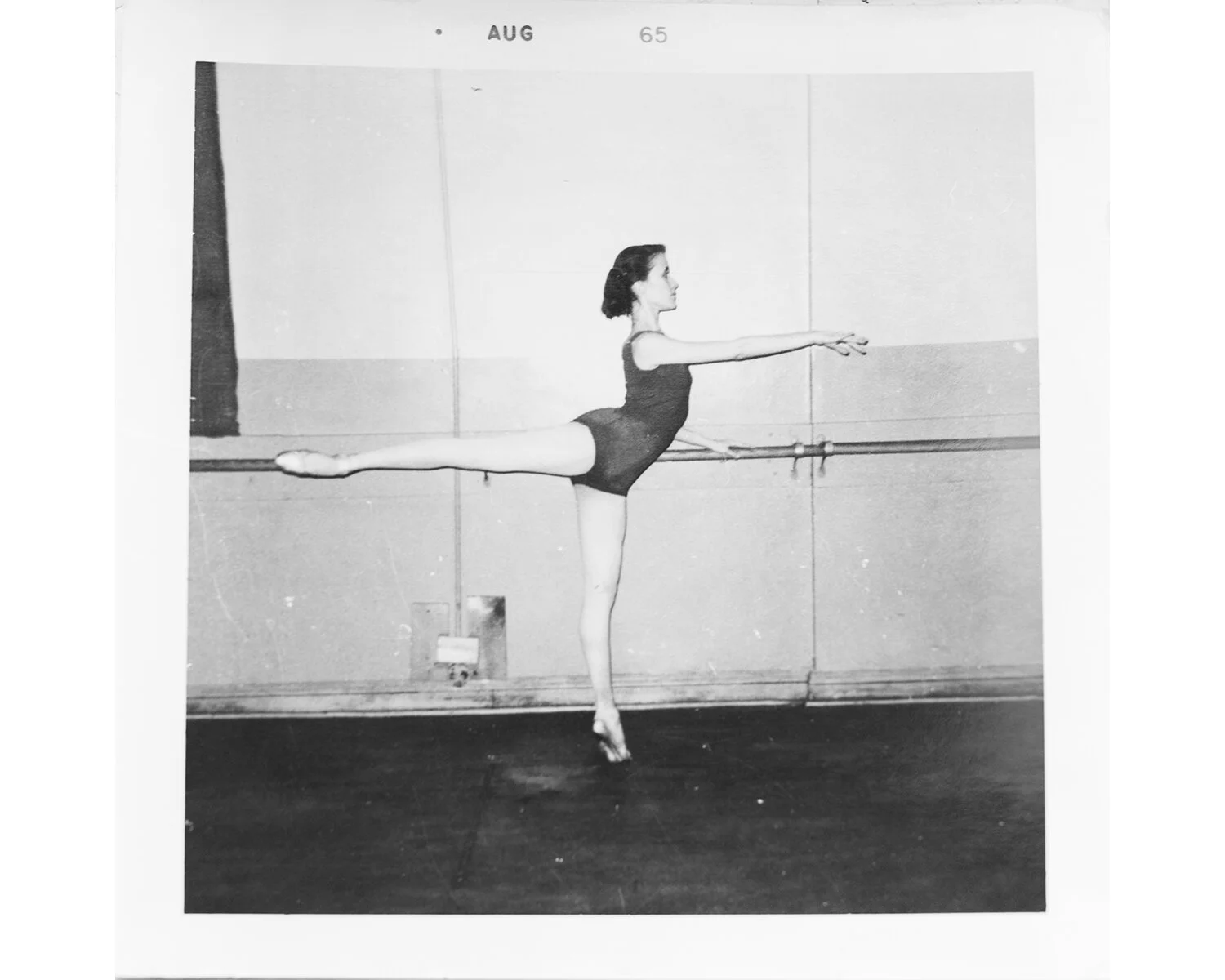
A young Linda Leven practicing ballet. Photograph republished in “Coda” by Elizabeth Bick.
Linda was born in Pittsburgh to parents with contrasting personalities, leading the way for her interest and involvement in both mathematics and the arts. “My daddy,” who she states she inherited her looks from, “was a really heady, intellectual lawyer. My mother was an alcoholic, but she had a lot of talents, and she loved the arts. She leaned toward ballet, and dance, and music. I’m split between the two of them,” she says. Driven by both her education and her love for dance, Linda’s youth was spent simultaneously studying to academic excellence and learning and perfecting her technique in ballet.
“All the time I studied ballet because I wanted to dance, that was coming from my mom’s side. She got me into it. I love theater, I love opera, ballet, music, arts, sculpting, photography. I love it all. But on the other hand, I am extremely logical, rational, technical – all the opposite things of an artist,” she says.
After graduating at the top of her high school class, Linda moved to New York to pursue a degree in mathematics at NYU (and later went on to earn a master’s degree in mathematics at NYU as well, where she also graduated with top honors). Her years at university were strictly focused on studying and ballet. “I never had a date. I never met a person through all of college, or high school for that matter. I studied all the time,” she says. “When that was done, I would go off to my ballet class – I took two classes every single day – and came home and studied. I met no one, did nothing except dance and study.”
This made for a tense relationship with her roommate in the dorms, who preferred partying to academics, and became hysterical at the sight of Linda applying Bengay menthol gel to her ballet injuries each night. Linda didn’t mesh with traditional college life, and eventually she had to seek other living arrangements.
Any time at her disposal outside university and professional ballet classes was spent auditioning for ballet companies in the city. She even auditioned with the “father” of American ballet, George Balanchine, a co-founder of the New York City Ballet. Her years of studying through undergraduate and graduate school were funded by her father, even her high rise luxury apartment on Fifth Avenue – which she still lives in today – was paid for by him.
However, as Linda became more and more dedicated to dance, her body suffered the consequences. “I was pushing it, pushing it every day going beyond what my body could do,” she said. “I went beyond perfect. I had arthritis in every joint and I could barely dance. I used to walk around saving myself during the day so I could dance in the evening. I could barely walk, but I got through classes.”
On top of the physical damage, she was facing constant rejection in auditions. “I was great technically, I was almost perfection,” she said, “but my artistry was lacking. I was almost like an automaton, so I never got anywhere.”
With her regular auditions being fruitless in landing her at a major dance company, and her body constantly in pain with multiple injuries, eventually her father cut her off financially. “Finally, Daddy said ‘Time’s up. No more money. You’ve got to get a job,’” she said of the beginning of the end of her ballet ambitions. “Dancing for 25 years, it’s your life, it’s really hard to drop it, but I had to or I’d be crippled.” A rational mind is what separates Leven from many great ballerinas – Anna Pavlova, who died after continuing to dance despite requiring surgery for her eventually fatal pleurisy, comes to mind.
“I think I’m too rational, too logical, wasn’t willing to give everything up for my art,” Leven says in retrospect. “I wanted to dance, but I was not willing to give up my degrees and getting my education. I danced for the technique.”
After receiving her master’s degree, Leven began her nine-to-five career teaching geometry and algebra at an all girls high school, a job which she immediately hated. “[The students] didn’t want to do math. They didn’t care about it, and I didn’t care about them,” she admits. “I couldn’t have cared less. I was in the wrong profession.” After leaving that position, she found work writing code for IBM, a job she held for 30 years until her retirement.
Even in her professional life, Leven continued to seek out further education. “Do you know who the author Ayn Rand is?” She asks me. “I’m a student of her philosophy,” she continued.
Rand was teaching a course with Nathaniel Branden at his namesake institute, NBI, an organization that endorsed the teachings of Rand’s philosophy of Objectivism, which, incredibly simplified, is a concept wherein one’s own happiness is the moral objective of life. The class consisted of 16 lectures and took place in the basement of the Empire State Building. Leven enjoyed it so much, she took it twice. “I met Ms. Rand. I am an advocate of her philosophy. Almost everything that she writes, I had thought that long before I met her,” she says. “‘Atlas Shrugged,’ that’s the bible if you can get through that.”
Since giving up her dreams of dancing professionally, and especially since her retirement that has afforded her time to explore her passions beyond her mathematical métier, Linda Leven has been wading her way through various artistic outlets. Particularly interesting are her semi-fictional-yet-factually-based novels. According to Leven, all of her books are rooted in her real life experiences, however the reader will never know which parts of the novels have been fictionalized.
The themes of her stories vary from her background in dance and the injuries that thwarted her career, to her disdain for high school life, and the 30 years she spent working for IBM. “The Impassioned Escapades of Caroline W.” is a fictionalized account of Leven’s experience dating various men in search of stimulating passion to counterbalance what she felt was a monotonous existence. Pre-internet and app dating, Leven met, as she says, “3,000 men over a period of 10 years” through newspaper ads.
Her search for a life partner, however, was not related to a maternal desire to bear and raise children. “I don’t like kids. I have no interest in kids whatsoever. I never thought of it, and I didn’t have a kid, and I don’t miss it,” she says. “I’m actually glad I didn’t waste 20 years of my life, because that’s what it is. This person whom you’re raising goes off, becomes another individual, and may even abandon you. I hate to think my dad lived for me. I don’t see the point of it. I was very selfish. I wouldn’t give up a minute of my time for a kid.”
She advises me, though, that a life partner is crucial to one’s happiness, especially as the years go on. “I’ll tell you one thing,” she says, “do have someone in your life. That is important. When you get to my age, I’ll tell you, it is so important to just have someone, even if you’re friends, who you can be with. It gets lonely, and you really need to be with somebody. You need each other.” Speaking of her boyfriend who she now has been with for decades, she says, “We help each other out. It’s just good to have someone.”
“The Finale’s Master Stroke,” a novella by Leven that follows four female artists in search of a type of immortality through fame, was reprinted in excerpts in the photography book “Coda” by Elizabeth Bick. According to Max Campbell’s write up of the book in The New Yorker, Bick first saw Leven on the F train in New York where her distinctive look drove Bick to hand Leven her business card, urging her to contact her if she had any interest in modeling for some photographs. Those subsequent photographs were bound into the book “Coda,” which also includes vintage captures from Leven’s days as a ballerina. Bick recalled that, after asking Leven to continue to be her muse, Leven responded with, “I am your canvas. You do what you want.”
Leven seems wholly unoffended by the various ways in which artists display her in their work, and those artists take full advantage of her malleability in showcasing that which might embarrass another less agreeable model. “I have a missing breast from breast cancer. I have an implant, but they don’t look normal,” says Leven. “Some male photographer met me and he thought, ‘Something bizarre, something ugly. Oh, great.’ He used [the photo] on the invitation for his show. It was a picture of me lying like a dead body, and he shot down on my breasts, and they were very visible.” Her tone of voice in relaying this to me is a metaphorical shrug of the shoulders. “I don’t care,” she says. “What do I care?”
Surviving breast cancer was not the last of Leven’s health complications, and she’s currently battling ovarian cancer and issues with her heart. Her daily activities include both her artistic ventures and regular doctors appointments, and she informs me that in 2018 she saw over 100 doctors. When asked how she’s dealt with the changes to her body over the years while still maintaining an active and creative life, she notes that she’s dealt with multiple afflictions since she was a child.
“When I was dancing, I developed joint pains, some were arthritic, some they didn’t know why I had them. I spent a lot of time with doctors when I was young. I was trying to keep dancing and survive this pain that I had for 10 of the 25 years I danced. I danced with pain every day, so I’m no stranger to pain,” Leven remarks.
On the topic of mortality and growing older, Leven admits to me her nagging fear. As is the case with most people, let alone students of philosophy, thoughts of death and what becomes of personhood in the wake of it are often hard to shake. “I had this epiphany when I was about 10 or 11, I suddenly realized I was mortal,” she tells me. “The idea, it’s hard. You have to sit in a room and try to think of your nonexistence … I think [that thought] can have two effects, it can shackle you and stifle you, or it can drive you, and that’s what’s driven me my whole life.”
Despite the subjectivity of fame, Linda has aimed for the spotlight since she was young. One might consider a portrait in the MoMA or a published book full of photographs of Leven as fulfilling that goal, but she has higher aspirations. “I want my name to go down in history big time. That, I feel, would compensate for my death, having to leave, that my name would be there in history for as long as it could be. Hundreds of years like Beethoven, or Chopin, or Rudolf Nureyev, Einstein, or Donald Trump. You know he’s going to go down in history. That’s big time fame, and that’s what I’ve shot for from the time I was 10 years old.”
Until then, Leven continues to model, and write, and captivate those who happen upon her photographs, or spot her on the train headed uptown. At the time of our interview, she tells me that in the upcoming week she’ll be modeling alongside Tali Lennox at the Chelsea Hotel for a series of photographs. “This gentleman, who I think is a friend of [Tali’s], called and wants to shoot us together for this freak show,” she says. “I think I know who is going to be the freak.”